Perri was
on an earlier flight to Florida, flying solo from Boston, where we will meet up
in West Palm Beach. Yet we insisted she keep in touch during critical steps of her journey. And so she did, texting to let us know the cabhad arrived (first text, 5:15 a.m.), that she
arrived at the airport and was waiting to check her luggage (5:35 a.m.), that
she made it through security and she bought a Starbucks ice caramel macchiato
(6:19 a.m.), that she doesn't have (or forgot to pack) ankle socks for her
sneakers (6:21 a.m.), that she's enjoying the sunrise view at the gate (6:33
a.m.), that she boarded her plane (7:20 a.m.), that she was turning her phone
off (7:29 a.m.). Whew!Tuesday, March 26, 2013
Learn To Fly
Perri was
on an earlier flight to Florida, flying solo from Boston, where we will meet up
in West Palm Beach. Yet we insisted she keep in touch during critical steps of her journey. And so she did, texting to let us know the cabhad arrived (first text, 5:15 a.m.), that she
arrived at the airport and was waiting to check her luggage (5:35 a.m.), that
she made it through security and she bought a Starbucks ice caramel macchiato
(6:19 a.m.), that she doesn't have (or forgot to pack) ankle socks for her
sneakers (6:21 a.m.), that she's enjoying the sunrise view at the gate (6:33
a.m.), that she boarded her plane (7:20 a.m.), that she was turning her phone
off (7:29 a.m.). Whew!Friday, March 15, 2013
People Are More Important Than Things
Tuesday, January 1, 2013
Happy New Year
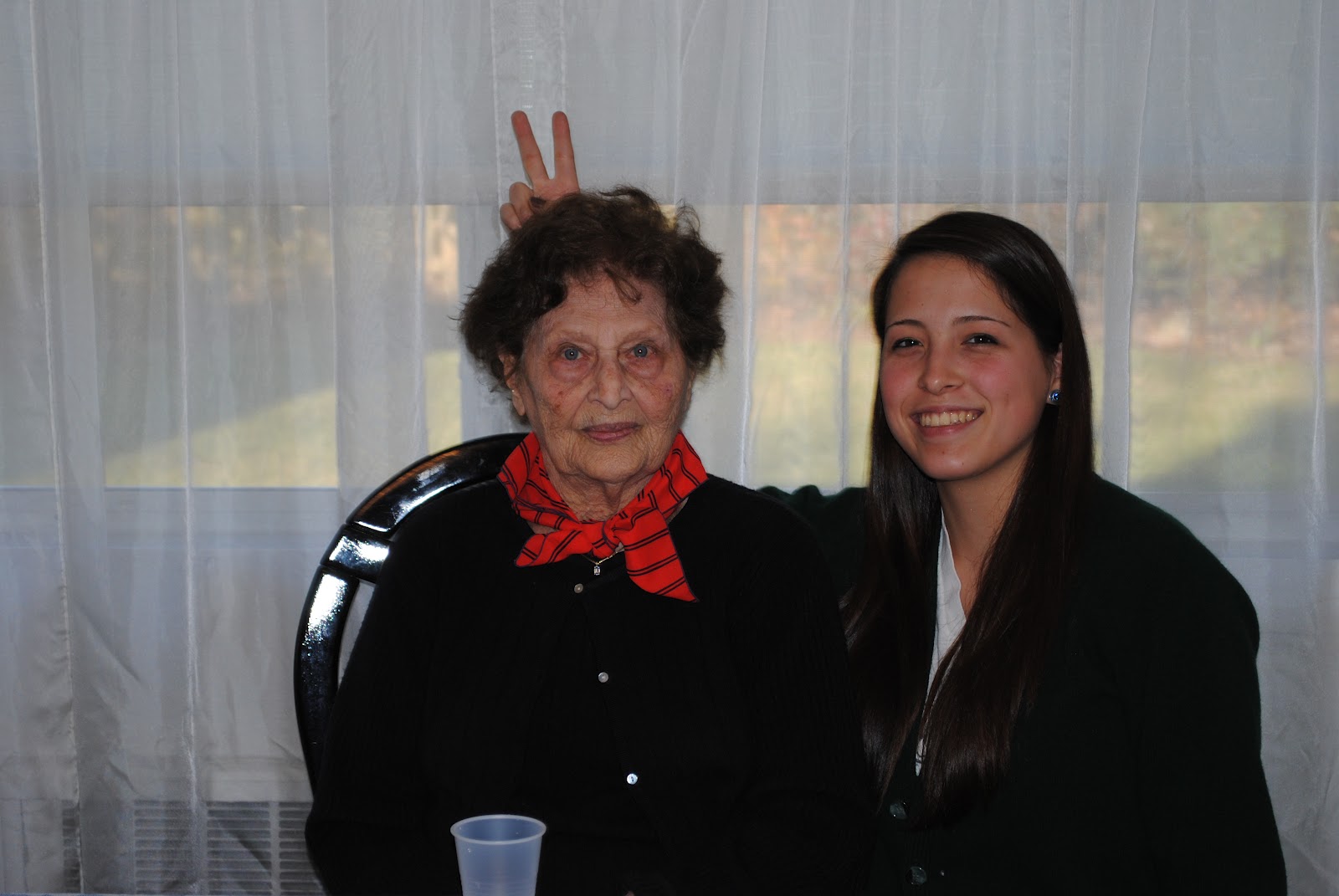
In years past, a few minutes after the ball dropped in New York City's Time Square I called my mom to wish her a happy new year. Last night was the first time in 55+ years that I have been unable to do so. All those wishes we shared for each other at 12:05 (after kissing our husbands and whatever friends we were partying with at the time) are now just memories. I have so much I still want to say to her but am unable to express.
In years past, I wished her another year of good health. While she has a strong will, each week that I visit I notice she is fading a little more, that muscles that once helped her sit up straight can no longer support her shoulders, that muscles that helped her smile are causing her mouth to droop. Thank goodness she can still express herself through her big, bright blue eyes. They light up when her grandchildren enter her room. They go large when there's something she agrees with, unable to voice the words. They cringe when she's in discomfort or doesn't like what she's being fed. I'm realistic enough to know that wishing her good health is fruitless; her health will not improve. But I wish her comfort and painlessness. I do not wish to see her suffer as she makes this final journey.
If my mother could speak, she would be wishing me good health as well. She would caution me about those extra pounds, about what I eat, about my much too sedentary lifestyle. So in her honor, I will try to be more mindful about my health, though red wine (supposedly good for the heart) will remain on my list!
In years past, I wished her another year of happiness. It was easy to make my mother happy—shopping, a visit with friends, an art show or trip to the museum, eating out or take-in Chinese, Scrabble games with anyone who would play with her (but especially with Marilyn), calls from her grandchildren, a good movie on tv, visits from her children, talking on the telephone with her friends, going to Florida in the winter, a whiskey sour. Unfortunately, her options are very limited these days. Partially deaf, bed bound and unable to speak, move, or eat anything but pureed food, she can't take pleasure in much. I know that she still enjoys hearing about the accomplishments of her children and grandchildren; she was always happy when we were happy. And I can bring her a whiskey sour the next time I visit!
If my mother could speak, she would be wishing me a year of happiness as well. She would tell me to look at the bright side and treasure the moment—the here-and-now. She would tell me to make more time for family and friends and to enjoy all the earthly things I can because our time here is so limited. She would tell me to travel, to read a good book, to go to a museum or ballet. So in her honor, I will live in the moment, cherish the rain as much as the sun, and even share that whiskey sour with her.
In years past, I wished her another year of dreams. My mother always said that being alive meant dreaming. It meant having a wish, a goal, something to strive for. It's what kept her going. A few years ago she shared some of her dreams—she wanted to see the Macy's Thanksgiving Day Parade from the viewing stands and she wanted to go to a fancy cocktail party on a yacht. More recently, it was to drive again. My brother understood that and insisted on keeping her car in her driveway after her brain surgery three years ago because he knew that it gave her a goal, something to strive for. He knew that it gave her hope.
If my mother could speak, she would be wishing me a year of dreams. She would tell me to aim big, to do something different that I hadn't done before. She would also tell me to enjoy the small stuff, because it is those moments that daydreams emerge. So in her honor, I will dream large and in multi-color...including orange.
In her honor, I wish you a year of health, happiness and dreams!
Tuesday, October 9, 2012
Find a Creative Outlet
| Really, what do you see? An eagle? or a Flower? |
Wednesday, March 7, 2012
Thinking About the Future Today
The other night, I learned that joy is being taken away from a friend, who recently learned he has early onset Alzheimer's.
According to the Alzheimer's Association (www.alz.org), nearly four percent (about 200,000 people) of the 5.4 million Americans with Alzheimer's have early onset. Here are 10 warning signs offered by the association:
- Memory loss that disrupts daily life.
- Challenges in planning or solving problems.
- Difficulty completing familiar tasks at home, at work, or at leisure.
- Confusion with time or place.
- Trouble understanding visual images and spacial relationships.
- New problems with words in speaking or writing.
- Misplacing things and losing the ability to retrace steps.
- Decreased or poor judgment.
- Withdrawal from work or social activities.
- Changes in mood and personality.
My friend and his wife (also a dear friend!) have filled their lives with good times. They are worldwide travelers and have collected memories and memorabilia from wherever they have gone. They go to plays and museums. They open their home to friends and strangers at holidays and throughout the year. Just passing through? They have a spare bed and are eager to offer you a place to stay; and while you're here, they are happy to show you the local sites. Their calendar and their hearts are full.
Lack of funds has never deterred them from taking in the world. Doug and I are always concerned about saving for that proverbial rainy day that we often forgo doing things in order to save just a little bit more (this habit long drilled into me by my Depression Era father). I once asked her about this.
"My mother always had a to-do list," she explained. "Places she wanted to go, things she wanted to accomplish, and then she died unexpectedly at age 59." My friend vowed that, since she never knew when her own time would be up, she would pack as much into life as she could. She didn't want to have regrets about not doing, not seeing, not using the good china so many of us keep in the closet waiting for a special occasion. And now, even facing tough times ahead, my friends continue to pack living into their lives.
I so admire them, and my scrap of paper is a note to myself on how to live my life from this day forward. I vow to live my life in the moment, to pack as much joy and experience into the now, to make time for those hobbies, people, travel I have been saving for, and to tackle the wish list now.
I, too, don't want to have regrets. I vow to open my home and heart to friends and strangers—just like my dear friends.
Tuesday, February 14, 2012
An Interview with Grandma Garie
My Grandma Garie, 92 years old
Where were you born?
I was born in New York City, in the Harlem hospital on December 19, 1919.
I had quite a few. My sisters and I had to be upstairs by 3:30 to 4:00 pm. We lived on the top floor of a five-story building because my mom did not like the idea of people walking on our heads. My sisters and I peeled the potatoes and washed our hands. We rotated each week who would set the table, take off from the table, and swept the floor. If my parents were not home yet, I would start my homework. Every week we all changed our linens. We cleaned the closets every season, and for holidays we polished the silverware.
Describe your family.
My father was a tailor, and my mother was a finisher in the garment industry. I was the oldest child and had two sisters. Helen is l to 2 years younger than me, and Miriam is 4 to 5 years younger than me. My grandma had 12 children when she was young. My uncles were married. I had an Aunt Lily who worked for the Hershey factory, where I helped package.
What kind of educational experiences did you and your siblings have?
I went to high school, college and graduate school. My sisters and I were in advanced classes. My sisters trained in schools for commercial subjects. When I went to Hunter College, I did not have to pay for anything except for the books. I was a science major who then taught science. My sister Miriam went to college when she was older and had night classes.
How did you get to school?
I went to high school by trolley car. If I spent my trolley money, I had to walk. I commuted to college by train.
Any favorite teacher or subjects in school?
Oh yes. My gym teacher Ms. Pearl Satlien. She encouraged me to participate in as many activities as possible. On weekends, she took some of us to concerts, Broadway shows and dance groups and she paid. I got a very rounded background in Physical Education. I then majored in science because there was no Phys. Ed. major. I was also a gym teacher.
Science and music were my favorite subjects. My favorite science was biology. I loved singing and choir.
Did an historical event/situation change the structure within the family?
After my grandparents and father died, we celebrated holidays by my grandmas. But when my grandparents passed away, our family broke off into little groups to celebrate in different ways.
What was dating/courtship like?
Some levels were very difficult for me. The boys that I liked didn’t like me back. On the block I lived on, I liked Marty, but Marty didn’t like me, but his younger brother Julie liked me, so I liked him back. Seymour Weisberg worked for the New York Aquarium. It was my favorite date because he took me behind the scenes to show me what working at the aquarium was like.
Do you remember your first date? Where did you go? How did you get there?
Not really. I was a tomboy, so I wasn’t asked out on dates a lot. Instead the boys asked me to play sports and the girls asked me to play jump rope. The date with Seymour Weisberg was one of my first dates. We took the train to the aquarium.
What language was spoken in your home?
English. My mother and father spoke Yiddish when they didn’t want us to know what they were talking about. But we started to understand some of it.
What type of clothes did you wear when you were little?
My father was a tailor so he made us coats or something special to wear. In the Bronx Junior High School in the 1930s, we wore white middie blouse, a black tie, black skirt, and black stockings. No other junior high school wore this in New York City. We didn’t wear shorts to school, so we wore black bloomers under our skirts. We would also wear the bloomers for gym.
What were some of your favorite toys or activities?
I played jump rope, double Dutch rope, and the high lo rope game held by two people. The game was played by elevating the rope. We played ball games such as handball. The rhyme one two three O’Leary game was played with a ball. Clapsy was part of the one two three O’Leary game, where you clapped hands, or stomped your feet for stampsy clapsy. I played hide and go seek and box ball. We played potsy games with chalk. There were two variations: piece of folded can top or piece of class or a rock that was yours to use for the whole game. Potsy was the thing you threw.
How strict were your parents?
Very strict because they were both working. After school, we put our books upstairs and had a glass of milk and cookies and then we could go downstairs and play the previous games. We had to be back up in the house by 4:30 and wash our hands and set the table for supper. When I was older, I had to peel so many potatoes and put them in the water. I had to practice for one hour on the violin. There were no strict rules because we were doing things all the time and there was always homework.
Did your family go on any trips every year?
My father’s older sister and her family owned a farm in Fitchville, Connecticut. We would go there for two weeks and stay in Tanta Sadie’s facilities and work on her farm. We swam in the Connecticut River, hiked, picked wild strawberries, and watched the cows get milked. My mother and father had a house in Coney Island for about three years, and we went to school there. I went on the boardwalk and swam in the ocean. Also we went to Manhattan to visit Bubba on 98th street and Park Avenue.
How religious was your family?
My grandparents were very religious, and my father and mother were religious. We went to temple for the holidays. Momma lit the candles for shabbas. I didn’t really have any non-Jewish friends.
Sunday, July 10, 2011
Color Me Orange
“Who told you that one paints with colors? One makes use of colors, but one paints with emotions.” —Jean-Baptiste-Simeon Chardin, 18th century French painter
I grew up with a variety of colors—a pink room, a red front door, a grey carpet in the living room, a yellow kitchen, a green buffet—or so I thought. There was never any brown (“I hate brown,” said my mother.); never any blue (“Blue is so sad,” she said.); and most definitely never any orange (“I don’t like orange!”).
Yet, in addition to being a teacher, my mother was an artist. An artist who doesn’t like colors?
Dale Chihuly would disapprove. “I never met a color I didn't like,” he is quoted as saying.
I’m sure she never would have labeled herself as an “artist.” That term was reserved for the elite who made their living from their art. Yet, for as far back as I can remember, she was either sketching, painting, doing pottery, or making jewelry. After she retired, she took a silver jewelry-making class through her local community school; she audited painting classes at Hofstra; she took pottery classes in Florida. Doug and I have several of her works of art framed on the walls of our home.
But throughout it all, she continued to “hate” orange. That was all to change, thanks to her granddaughter. When Perri was small, we spent a week visiting my mother at her place in Florida. Preparing for our visit, my mother went shopping for gifts—naturally. She picked out turquoise leggings and a matching t-shirt for Perri. Alas, the outfit did not fit, so mom took us to the store to exchange it.
“You can just get a larger size or pick out anything from this display you like better,” my mom said to Perri.
Wrong words. Even then, Perri was an independent thinker, especially when it came to clothes, color, and art. She picked out bright orange leggings and a matching orange and hot pink t-shirt.
“I don’t like orange,” said my mother.
“I do, Grandma,” replied the cutest five-year-old you’ve ever seen.
Guess who won? “Orange is the happiest color.”—Frank Sinatra
“Orange is red brought nearer to humanity by yellow.”—Wassily Kandinsky
Color makes me happy. As I age, I want to remember to not only paint with the colors, but feel them—all of them, even orange.